Home Blog Page 14

Cavalleria Rusticana part 2

0

“It is a blessing to have sight of you!” said he.

“Oh, friend Turridu, I was told that you came back around the first of the month.”

“And I too was told many other things besides!” he answered. “So it is true that you are going to marry Alfio the carter?”

“If such is the will of God!” answered Lola, drawing together beneath her chin the two comers of her kerchief.

“You do the will of God by taking or leaving as it pays you best!

And it was the will of God that I should come home from so tar away to hear such fine news, Mistress Lola!”

The poor fellow still tried to make a show of indifference, but his voice had grown husky; and he walked on ahead of the girl with a swagger that kept the tassel of his cap dancing back and forth upon his shoulders. It really hurt the girl to see him with such a long face, but she had not the heart to deceive him with fair words.

“Listen, friend Turridu,” she said at length, “you must let me go on to join the other girls. What would folks be saying if we were seen together?”

“That is true,” replied Turridu; “now that you are to many Alfio, who has four mules in his stable, it wont do to set people talking. My mother, on the other hand, poor woman, had to sell our one bay mule, and that little bit of vineyard down yonder on the highroad, during the time that I was soldiering.

Window to courtyard

The time is gone when the Lady Bertha span; and you no longer give a thought to the time when we used to talk together from window to courtyard, and when you gave me this handkerchief just before I went away, into which God knows how many tears I wept at going so far that the very name of our land seemed forgotten. But now good-bye, Mistress Lola, let us square accounts and put an end to our friendship.”

Mistress Lola and the carter were married; and on the following Sunday she showed herself on her balcony, with her hands spread out upon her waist, to show off the big rings of gold that her husband had given her.

Turridu kept passing and repassing through the narrow little street, with his pipe in his mouth and his hands in his pockets, pretending in-difference and ogling the girls; but inwardly he was eating his heart out to think that Lolas husband had all that gold, and that she pretended not even to notice him as he passed by.

Read More about Isaac Comnenus 9
Cavalleria Rusticana part 1

0

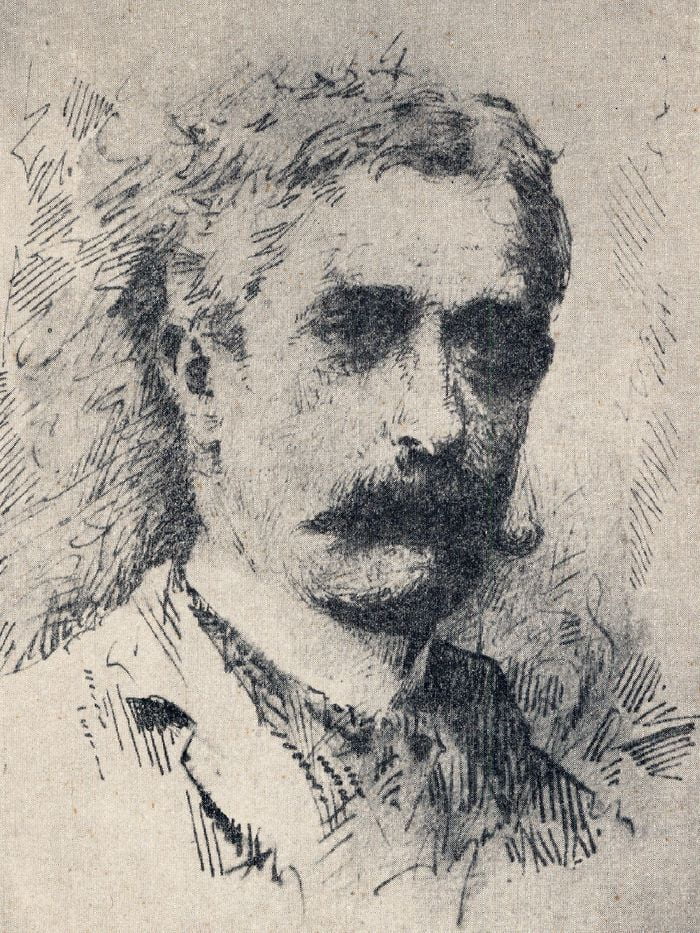
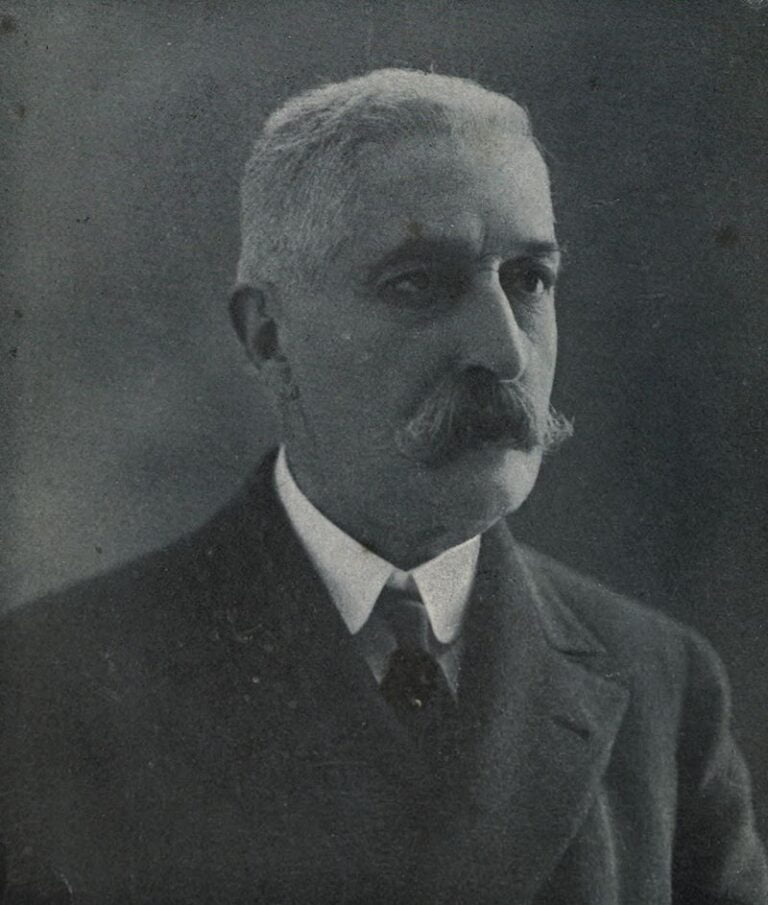
Giovanni Verga (1840—1922)

With Verga we find ourselves in modern times. The dawn of the Nineteenth Century found Italy in the full flood of that romanticism that was popularized by Byron and Scott. The figure of Manzoni dominated Italian fiction until the end of the Nineteenth Century.

Verga was born in Catania, Sicily, in 1840. His most significant work is his stories of Sicilian peasant life. The most celebrated is Cavalleria Rusticana, which was later adapted as the libretto of Mascagnis opera. Even the music has not entirely deprived the tale of its moving power. Verga is reckoned as one of the forerunners in the modern Italian dramatic movement.

The present version is translated by Frederic Taber Cooper. Co-pyright, 1907, by P. F. Collier and Son, and here reprinted by permission of P. F. Collier & Son Company.

Cavalleria Rusticana

After Turridu Macca, Mistress Nunzias son, came home from soldiering, he used to strut every Sunday, peacock-like, in the public square, wearing his riflemans uniform, and his red cap that looked just like that of the fortune-teller waiting for custom behind the stand with the cage of canaries. The girls all rivaled each other in making eyes at him as they went their way to mass, with their noses down in the folds of their shawls; and the young lads buzzed about him like so many flies.

Besides, he had brought back a pipe, with the king on horseback on the bowl, as natural as life; and he struck his matches on the back of his trousers, raising up one leg as if he were going to give a kick.

But for all that, Master Angelos daughter Lola had not once shown herself, either at mass or on her balcony, since her betrothal to a man from Licodia, who was a carter by trade, and had four Sortino mules in his stable. No sooner had Turridu heard the news than, holy great devil! but he wanted to rip him inside out, that was what he wanted to do to him, that fellow from Licodia. However, he did nothing to him at all, but contended himself with going and singing every scornful song he knew beneath the fair ones window.

“Has Mistress Nunzias Turridu nothing at all to do,” the neighbors asked, “but pass his nights in singing, like a lonely sparrow?”

At last he came face to face with Lola, on her way back from praying to Our Lady of Peril; and at sight of him she turned neither white nor red, as though he were no concern of hers.

Read More about The Matron of Ephesus 2

The Shipwreck of Simonides 1

0

Phaedrus (15 B.C.?—55 A.D.?)

It was the chief distinction of this writer to have collected the Fables of Jesop (or whoever it was who wrote Alsops works) and rewritten them for the Romans. His collection is the earliest of its kind which has survived. Not all his Fables, however, are based upon Tsop. The Shipwreck of Simonides is either an original composition or was taken from another source. Phaedrus was a Thracian slave, and later a freedman, in the service of the Emperor Augustus. He once declared that the fable was invented as a “device whereby slavery could find a voice,” a definition which throws considerable light on Phaedrus life, even if it fails to explain the origin of the Fable form.

The present text was first published in the Bohn edition of Phaedrus in 1848.

The Shipwreck of Simonides

A lerned man has always a fund of riches in himself.

Simonides, who wrote such excellent lyric poems, the more easily to support his poverty, began to make a tour of the celebrated cities of Asia, singing the praises of victors for such reward as he might receive. After he had become enriched by this kind of gain, he resolved to return to his native land by sea (for he was born, it is said, in the island of Ceos). Accordingly he embarked in a ship, which a dreadful tempest, together with its own rottenness, caused to founder at sea. Some gathered together their girdles, others their precious effects, which formed the support of their existence. One who was over inquisitive, remarked: “Are you going to save none of your property, Simonides?” He made reply:

The story has been taken from istanbulgaria.info. Whole story can be read on link The Shipwreck of Simonides.

Read More about Diego Endara Tour

The Matron of Ephesus 2

0

Maidservant

But she was ill-pleased by such commonplace consolation, and smote her breast more violently than ever, tearing out her hair and throwing it upon the body before her. Still, the young soldier did not leave. He tried to give the woman food. Though she resisted, her maidservant was won over by the smell of the wine, and stretched out her hand for the supper that was offered her. After she was fortified by food and drink, she strove to win over her mistress. “How,” she asked, “will you be benefited, if you starve to death and bury yourself alive, dying before Destiny has demanded your soul? Do you imagine that your mourning can be acceptable to the body or the soul of a man who is dead and buried? Why not rather begin your life anew? Why not forget this misguided fidelity— adhered to only by women—and enjoy the daylight as long as the gods allow? This cold body ought to be a warning to you to enjoy life to the utmost.”

Now, generally, one gives heed when one is asked to eat food or to live, and the matron was both hungry and thirsty after five days fasting; she allowed her resolution to be broken. She ate as greedily as the maidservant had eaten. Those who are well-fed are easily tempted, and the soldier set about to conquer the matrons virtue, by the same pleasant and persuasive means he had used before. The chaste matron perceived that he was an attractive young man, and by no means a fool. The maidservant was sympathetic, and quoted the words, “Do you seek to struggle against a passion that is pleasing to you? Do you not remember in whose country you are?”

To make a long story short, having overcome certain of the matrons scruples, the soldier succeeded in overcoming her remaining scruples.

They were together not only on that first night, but on the second and the third. The gates of the sepulcher were closed, so that if any friend or stranger had come, he would have imagined that the very virtuous woman had died in the presence of her husbands body. The soldier was greatly pleased by the matrons charms, and with their uninterrupted love; he bought such delicate viands as his pay would permit, and brought them to the sepulcher when darkness came.

The parents of one of the thieves who had been crucified, perceiving that the soldier was not strictly guarding the crosses, took down the body of their son and buried it. Next morning, seeing the body gone, the soldier knew what his punishment would be, and went and told the woman. He would, he declared, kill himself with his sword rather than be sentenced by a military court, and told her to make room for her lover to lie beside her late husband.

But the lady was as compassionate as she was pure. “May the gods forbid,” said she, “that I should lay eyes at one time on the corpses of the two men who are dearest to me! It were better to hang up a dead body than to kill a breathing man.” And therewith she told the soldier to take the husbands body from its place and put it upon the cross that was vacant. The soldier at once acted upon the matrons clever suggestion, and the next day people wondered how the dead man had been able to crucify himself.

Read the rest of the story on link The Matron of Ephesus.

Read More about Isaac Comnenus 7

The Jackal 2

0

The rest of the jackals, seeing him of such a fine complexion, prostrated themselves before him, and said: “According as Your Highness commands!” By this step he made himself honored by his own relations, and so gained the supreme power over those of his own species, as well as all the other inhabitants of the forests. But after a while, finding himself surrounded by a levee of the first quality, such as the tiger and the like, he began to look down upon his relations; and, at length, he kept them at a distance.

The rest of the jackals, seeing him of such a fine complexion, prostrated themselves before him, and said: “According as Your Highness commands!” By this step he made himself honored by his own relations, and so gained the supreme power over those of his own species, as well as all the other inhabitants of the forests. But after a while, finding himself surrounded by a levee of the first quality, such as the tiger and the like, he began to look down upon his relations; and, at length, he kept them at a distance.

Lion

A certain old jackal, perceiving that his brethren were very much cast down at this behavior, cried: “Do not despair! If it continue thus, this imprudent friend of ours will force us to be revenged. Let me alone to contrive his downfall. The lion, and the rest who pay him court, are taken by his outward appearance; and they obey him as their king, because they are not aware that he is nothing but a jackal: do something then by which he may be found out. Let this plan be pursued: Assemble all of you in a body about the close of the evening, and set up one general howl in his hearing; and Ill warrant you, the natural disposition of his species will incline him to join in the cry for.

Whatever may be the natural propensity of anyone is very hard to be overcome. If a dog were made king, would he not gnaw his shoe straps?

And thus the tiger, discovering that he is nothing but a jackal, will presently put him to death.” The plan was executed, and the event was just as it had been foretold.

This story has been taken from www.ensartourguide.com; Read the rest of the story on link The Jackal.

Read More about The First Crusade part 29

The Haunted House 2

0

Intermingle

On being thus left to himself, he marked the spot with some grass and leaves which he plucked. Next day he applied to the magistrates, and urged them to have the spot in question dug up. There were found there some bones attached to and intermingled with fetters; the body to which they had belonged, rotted away by time and the soil, had abandoned them thus naked and corroded to the chains. They were collected and interred at the public expense, and the house was ever alterwards free from the spirit, which had obtained due sepulture. I believe on the strength of those who affirm it. What follows I am myself in a position to affirm to others. I have a ireedman, who is not without some knowledge of letters.

A younger brother of his was sleeping with him in the same bed. The latter dreamed he saw some one sitting on the couch, who approached f Pair of scissors to his head, and even cut the hair from the crown of it. When day dawned he was found to be cropped round the crown, and his locks were discovered lying about. A very short time afterwards a fresh occurrence of the same kind confirmed the truth of the former one. A lad of mine was sleeping, in company with several others, in the pages apartment. There came through the windows (so he tells the story) two figures in white tunics, who cut his hair as he lay, and departed the way they came. In his case, too, daylight exhibited him shorn, and his locks scattered around. Nothing remarkable followed except, perhaps, this, that I was not brought under accusation, as should have been, if Domitian (in whose reign these events happened).

For ln his desk was found an information against me which had been presented by Cams; from which circumstance it may be conjectured inasmuch as it is the custom of accused persons to let their hair grow—that the cutting off of my slaves hair was a sign of the danger which threatened me being averted.

I beg, then, that you will apply your great learning to this subject.

The matter is one which deserves long and deep consideration on your part; nor am I, for my part, undeserving of having the fruits of your wisdom imparted to me. You many even argue on both sides (as vour way is), provided you argue more forcibly on one side than the other so as not to dismiss me in suspense and anxiety, when the very cause of my consulting you has been to have my doubts ended.

Follow the rest of the story on link The Haunted House.

Read More about Ancient Bulgaria tour

The Dove and the Crow 1

0

The Dove And The Crow (Anonymous: 2nd Century B.C. or later)

It is thought that the collection of fables now known as the Panchatantra had assumed definite shape at least as early as the Sixth Century A.D., and it is possible that it dates back to the Second Century B.C. Nothing is known of the author. The little stories that make up the collection are mostly Beast Fables, which were originally designed to instruct young princes. “Panchatantra” means “five books.”

The present story, from the second book or Tantra, is reprinted from Ancient Indian Fables and Stories, by permission of the publisher, John Murray. It has no title in the original.

The Dove And The Crow

When Vishnu Sarma had finished telling and expounding these fables, his pupils were lost in admiration of their teacher, whose wisdom had been so clearly marked by his dexterous mingling of amusement with instruction. They rose and all three fell at his feet, thanking him for the wise lessons he had given them; they assured him that henceforth they would regard him as their guru and that they hoped with his help and advice to rise from the state of ignorance in which they had hitherto been. They prayed him to continue the work so happily begun and to give them more of his interesting lessons.

Vishnu Sarma was charmed to see that his pupils were well disposed and noticed with satisfaction that his plan had so far succeeded. He continued his task with enthusiasm and proceeded to tell them fresh fables.

“Now,” said Vishnu Sarma, “listen, my young princes, to the fable I am going to tell you. In the complex nature of this life we must all help one another. It is by this mutual help that the weak escape the dangers, to which they are exposed from the strong, as you shall now hear.”

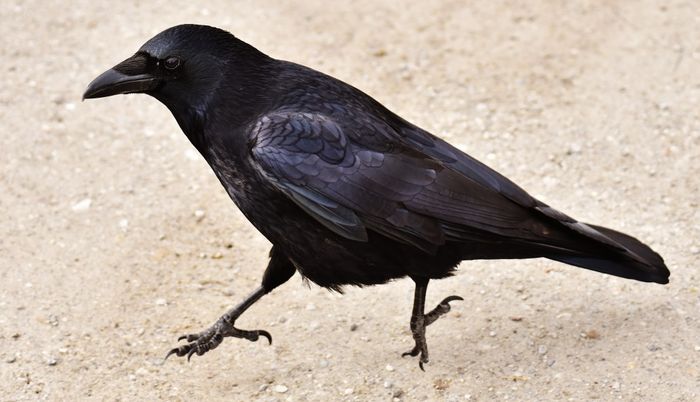
A certain dove, by name Chitrani, had built her nest on the top of the mountain Kanakachala and was living there comfortably with her family. At the foot of the mountain dwelt a crow. One day Vega- Varma (such was the crows name) was flying round in search of food when he noticed a fowler spreading his nets in the way. He was frightened at sight of the danger and at once returned home.

The dove Chitrani passed by the same place with her family, but being off their guard, they all flew into the net and were captured. What was to be done? How could they escape from certain death? There was in fact no escape, no hope of obtaining their liberty. Already the fowler was running up to seize his prey, when all at once under the impulse of danger they took to flight together, carrying with them the net that enclosed them. So they succeeded in escaping, and the fowler, who had reckoned upon his capture, was not a little surprised when he saw them fly away with his nets. But they reached their home in safety still entangled in the nets into which they had flown.

Hiranya Varma

When the crow saw them coming in this strange chariot, he hastened to meet them; and as soon as Chitrani saw him, she told him of their adventures and asked him to help them by disentangling the nets. The crow replied that he could not free them, but suggested a rat of the name of Hiranya Varma who lived close by and who could help them. Accordingly Chitrani called the rat, who came up at once, and when he saw the captives he began to scold Chitrani for her imprudence and folly which had brought them to this pass. Chitrani defended herself and quoted the maxim: “No one, be he never so wise or prudent, can escape his destiny.” Then the rat, pitying the poor doves, called his fellows, and they all set to work to gnaw the knots of the nets, so that very soon they had freed Chitrani and her family.

The crow, who had seen the signal service performed by the rat for the doves, was anxious to make friends with him; he hoped also to obtain a useful ally should occasion arise. He accordingly made over-tures to him; but the rat replied that they were of totally different species, the one living in the air and the other in the earth; he did not see the use of the close friendship of two creatures between whom Nature had fixed such a wide gulf.

This story has been taken from docappadocia.com; Read the rest of the story on link The Dove And The Crow.

Read More about Mrs Bullfrog Part 4

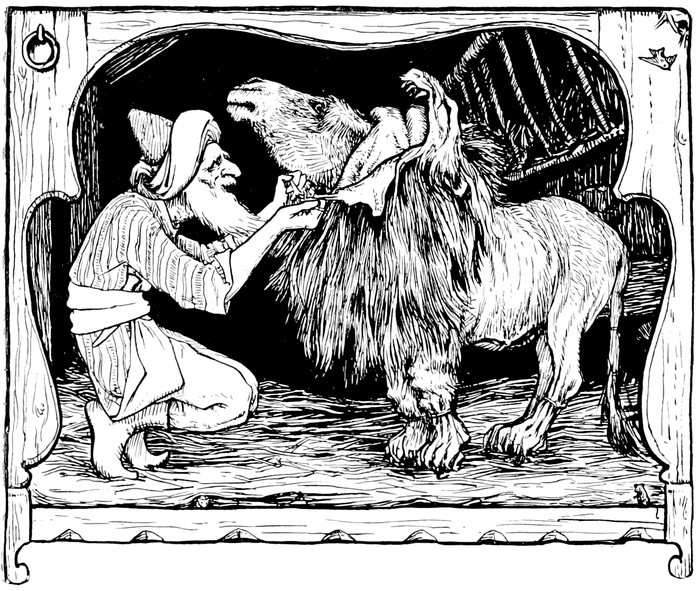
The Ass in the Lions Skin 1

0

Ancient India

Sanskrit is the classical language of the Hindus of ancient India. Practically the whole of that extraordinary literature which began with the Vedas and culminated some time before the close of the Middle Ages, was written in Sanskrit.

Our knowledge of the earliest period is vague. The Vedas were composed perhaps before the days of Homer. Beginning perhaps about 500 B.C. and extending to about the time of Christ, is the period of the epics, during which the Mahabharata and Ramayana were probably written. Both these monumental poems are full of episodes containing at least the material for short stories.

But for the purpose of this volume, the outstanding contribution of the ancient Hindus were the fables and tales, most of which are found in large collections. The earliest of these is doubtless the Jataka, or Buddhist “birth-stories,” which were in existence at least as early as the Fourth Century B.C. The Panchatantra may be as old as the Jataka stories; both are rooted in a common source. Many centuries later an unknown author revised certain parts of the Panchatantra and produced the book known as the Hitopadesa, which may be as recent as the Fourteenth Century A.D.

Most of these stories are directly didactic, but for the historian in search of the origin of certain types, the question of the fable and its Indian or Greek origin, is one of the most fascinating in all literature. There are those who claim that the tales in the Panchatantra and the Jataka stories are the source of all the fables in the Occident, and others who believe that it was the Hindus who took the fable form from the ancient Greeks.

Of the other collections of stories the most varied is the famous Katha-sarit-Sagara, or Ocean of Streams of Stories, written about 1070 A.D. by Somadeva. This was based upon a much earlier collection, which is now lost.

The influence of the Sanskrit tales on the art of the story is almost impossible to estimate: translations and revisions of Sanskrit tales and fables were made as early as the Sixth Century B.C., and modern research is demonstrating beyond any doubt the fact that the Ancient Hindus have furnished ideas and literary forms to other nations ever since the dawn of history.

The Ass in the Lions Skin (Anonymous: 500 B.C.?—380 B.C.?)

The Jataka or Birth-story is found in one form or another in several collections, one of which was well known as early as the Fourth Century B.C. It is a brief incident, usually in fable form, showing one incarnation of the Buddha, and drawing from the fable a little moral.

The Jataka may actually have influenced the ancient Greeks and given rise to the Jesop legends, but whether or not that is true, they constitute the “oldest, most complete, and most important collection of folk-lore extant.”

The whole text can be seen on link The Ass in the Lions Skin.

Read More about Rose Festival

Orpheus and Eurydice 1

0

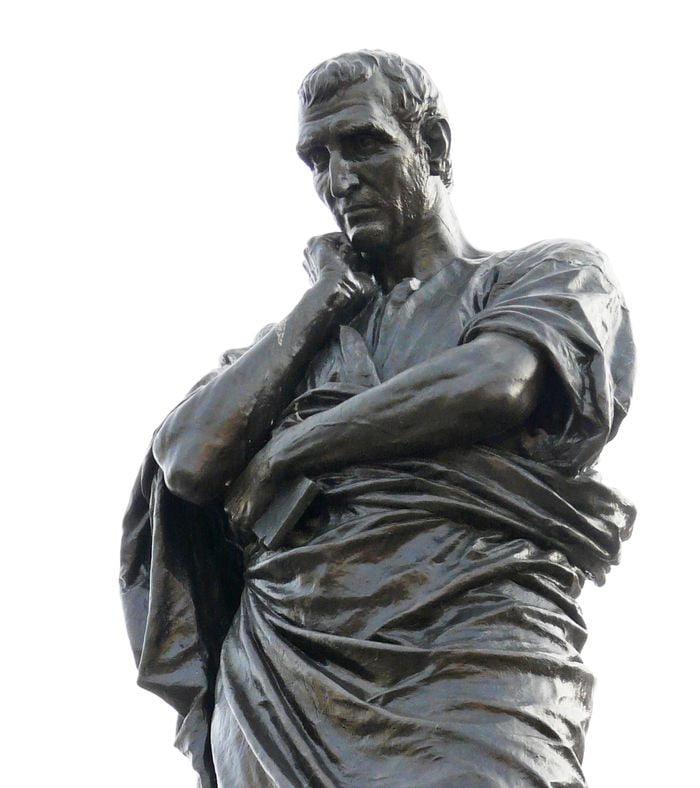
Ovid (43 B.C.—18 A.D.?)

Publius Ovidius Naso, better known to readers of English as Ovid, was born not far from Rome, and spent the latter part of his life in exile. The Metamorphoses, his most ambitious work, is an attempt to reshape in metrical form the chief stories of Greek mythology, and several from Roman mythology. Orpheus and Eurydice, one of the most human of the legends of antiquity, is a graceful piece of writing. Its “point” is as clear and as cleverly turned as you will find in any ancient tale.

The present translation is based by the editors upon two early versions, the one very literal, the other a paraphrase. The story, which has no title in the original, appears in the Tenth Book of the Metamorphoses.

Orpheus and Eurydice

Thence Hymenaeus, clad in a saffron-colored robe, passed through the unmeasured spaces of the air and directed his course to the region of the Ciconians, and in vain was invoked by the voice of Orpheus. He presented himself, but brought with him neither auspicious words, nor a joyful appearance, nor happy omen. The torch he held hissed with a smoke that brought tears to the eyes, though it was without a flame. The issue was more disastrous than the omen; for the new bride, while strolling over the grass attended by a train of Naiads, was killed by the sting of a serpent on her ankle.

After the Rhodopeian bard had bewailed her in the upper realms, he dared, that he might try the shades below as well, to descend to the Styx by the Taenarian Gate, and amid the phantom inhabitants, he went to Persephone and him who held sway over the dark world. Touching the strings of his harp and speaking, he thus addressed them:

“Oh, ye deities of the world that lies beneath the earth, to which we all come at last, if I be permitted to speak, laying aside the artful expressions of a deceitful tongue, I have not descended hither from curiosity to see dark Tartarus nor to bind the threefold throat of the Medusaean monster bristling with serpents. My wife is the cause of my coming, into whom a serpent which she trod on suffused its poison, and cut short the thread of her years. I wished to be able to endure this, and I will not deny that I have striven to do so.

But love has proved stronger. That god is well-known in the regions above; whether he be so here as well, I am uncertain. Yet I think that even here he is, and if the story of the rape of former days is true, twas love that brought you two together. By these places filled with terrors, by this vast chaos and by the silence of these boundless realms, I entreat you, weave over again the quickspun thread of the life of Eurydice.

“To you we all belong, and having stayed but a little while above, sooner or later we all hasten to your abode. Hither are we all hastening. This is our last home, and you possess indisputable dominion over the human race. She, too, when in due time she shall have completed her allotted number of years, will be under your sway. The enjoyment of her I entreat as a favor, but if the fates deny me this privilege on behalf of my wife, I have determined that I will never return to earth. Triumph, then, in the death of us both!”

The story above has been copied from ensaristanbul.com. You can read the rest of the story on link Orpheus and Eurydice.

Read More about Isaac Comnenus 5

The Country Mouse and the Town Mouse 2

0

A mouse, you know, does not live forever. So come with me and Ill show you life and the town.” Overpowered with such fine words and so polished a manner, the Country Mouse assented; and they set out together on their journey to town. It was late in the evening when they crept stealthily into the city, and midnight ere they reached the great house, where the Town Mouse took up his quarters. Here were couches of crimson velvet, carvings in ivory, everything in short that denoted wealth and luxury.

On the table were the remains of a splendid banquet, to procure which all the choicest shops in the town had been ransacked the day before. It was now the turn of the courtier to play the host; he places his country friend on purple, runs to and fro to supply all his wants, presses dish upon dish and dainty upon dainty, and as though he were waiting on a king, tastes every course ere he ventures to place it before his rustic cousin.

The Country Mouse, for his part, affects to make himself quite at home, and blesses the good fortune that had wrought such a change in his way of life; when, in the midst of his enjoyment, as he is thinking with contempt of the poor fare he has forsaken, on a sudden the door flies open, and a party of revellers returning from a late entertainment, bursts into the room. The affrighted friends jump from the table in the greatest consternation and hide themselves in the first corner they can reach.

Country Mouse

No sooner do they venture to creep out again than the barking of dogs drives them back in still greater terror than before. At length, when things seemed quiet, the Country Mouse stole out from his hiding place, and bidding his friend good-bye, whispered in his ear, “Oh, my good sir, this fine mode of living may do for those who like it; but give me my barley-bread in peace and security before the daintiest feast where Fear and Care are in waiting.”

The whole text can be seen on link The Country Mouse and the Town Mouse.

Read More about The Long Exile part 4